
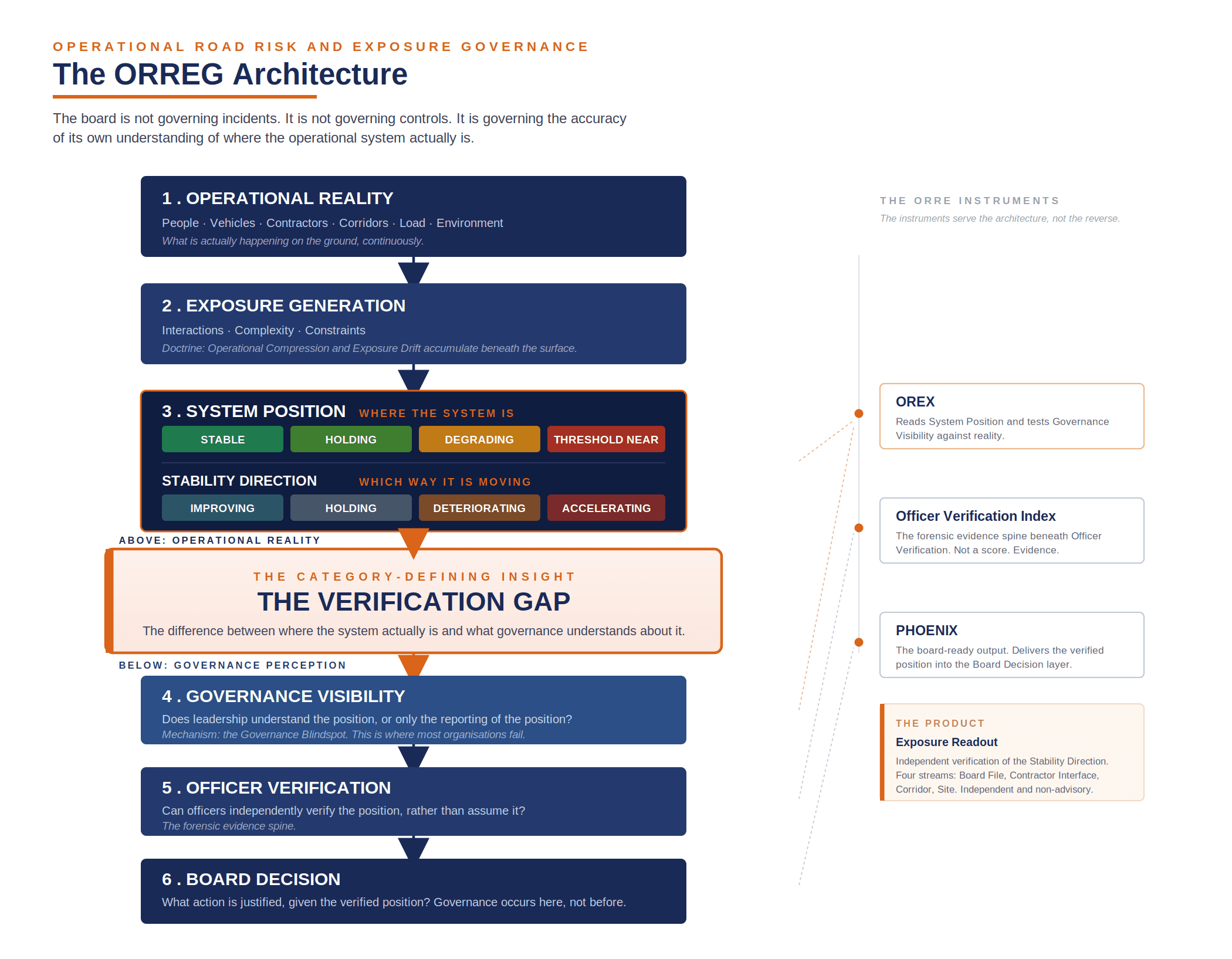
It is one of the most quietly dangerous assumptions inside Australian mining, contracting, port, infrastructure, and heavy industry boardrooms.
A declining TRIFR, a clean quarter, an audit closed out, a telematics dashboard within tolerance: these are often read as evidence of system stability.
They are not.
They are evidence of past output.
They do not independently verify present system condition.
Across Australian workplaces, vehicles and mobile plant remain one of the dominant fatality vectors. In heavy industry, mining, contracting, ports, infrastructure, and logistics, that exposure is not incidental. It is structural.
The boards governing those operations are often doing so with reporting systems designed to confirm what already happened.
Not what is currently building.
Not what is approaching threshold.
Not what is degrading silently under operating load.
That is the gap this category exists to name.
Current Reporting Answers What Happened, Not What Is Building
The instruments most boards rely on are confirmation instruments. TRIFR, lost-time injury rates, incident counts, audit completion percentages, control activity logs, and telematics event flags all sit in that category.
They report against events that have already occurred or controls that already exist.
None of them independently verify whether the operational road system is becoming more stable, holding, or becoming less stable under current operating load.
None of them independently verify the System Position: whether the operating system is holding its stability under current load.
None of them expose contractor interface density, operational compression, fatigue stacking, or engineering proportionality failure before those conditions resolve into an incident review, regulator investigation, coronial finding, or prosecution brief.
This is not a criticism of those instruments.
They do what they were designed to do.
The problem is that boards have been treating them as governance verification when they were only ever designed to be operational confirmation.
The gap between what was reported and what was actually building is where officer-level exposure begins.
Operational Road Risk & Exposure Governance — ORREG: The Missing Board-Level Category
It is not safety culture.
It is not fleet management.
It is not telematics.
It is not training.
It is not compliance auditing.
Those are operational disciplines, and they have their place.
ORREG sits above them.
ORREG asks a different question.
Not whether controls exist.
Not whether incidents have occurred.
Not whether a dashboard is inside tolerance.
The question is whether the system producing those controls, those movements, those interactions, and those reports is currently holding its stability under the load being asked of it.
That question has not had a category until now.
The Officer Question Is Verification, Not Policy Existence
Officer due diligence under the Model WHS Act, and the parallel verification logic emerging from decisions such as Gibson in New Zealand and Bekier in Australia, has moved the governance question past whether a policy was in place.
The question is now whether the officer could verify that the system being reported upward was actually performing as described.
Policy existence is not verification.
Audit completion is not verification.
Subordinate assurance is not verification.
A board pack reference buried inside ordinary reporting is not verification.
Verification is independent, contemporaneous evidence that the operational system carrying the duty of care is in the state the board is being told it is in.
That is what officers are now expected to be able to demonstrate.
Not after the event.
Before it.
OREX Examines Structural Exposure After a Readout Identifies a Material Gap
OREX is the diagnostic instrument purpose-built to answer the ORREG question.
It reads the System Position and tests whether governance understanding matches it. The output is an independent, contemporaneous reading of whether road-related operational exposure can be evidenced as stable, or whether the organisation is relying on assumed control at the time of measurement.
It is not a safety audit.
It is not a telematics review.
It is not a compliance check.
It is structural exposure verification, designed to produce the evidence a board needs before officer-duty scrutiny arrives through incident reconstruction.
If a Board Cannot Answer This, It Is Assuming Stability
There are two positions a board can hold on operational road risk and exposure.